




Everybody in this industry knows they will not do it forever, and almost nobody acts on that knowledge until the decision is being made for them. The people who leave comfortably are not the ones who earned the most; they are the ones who started building something else while the income was still good. That work is slower and less interesting than a busy Saturday, and it is the single highest-return thing you can do with a free weekday afternoon.

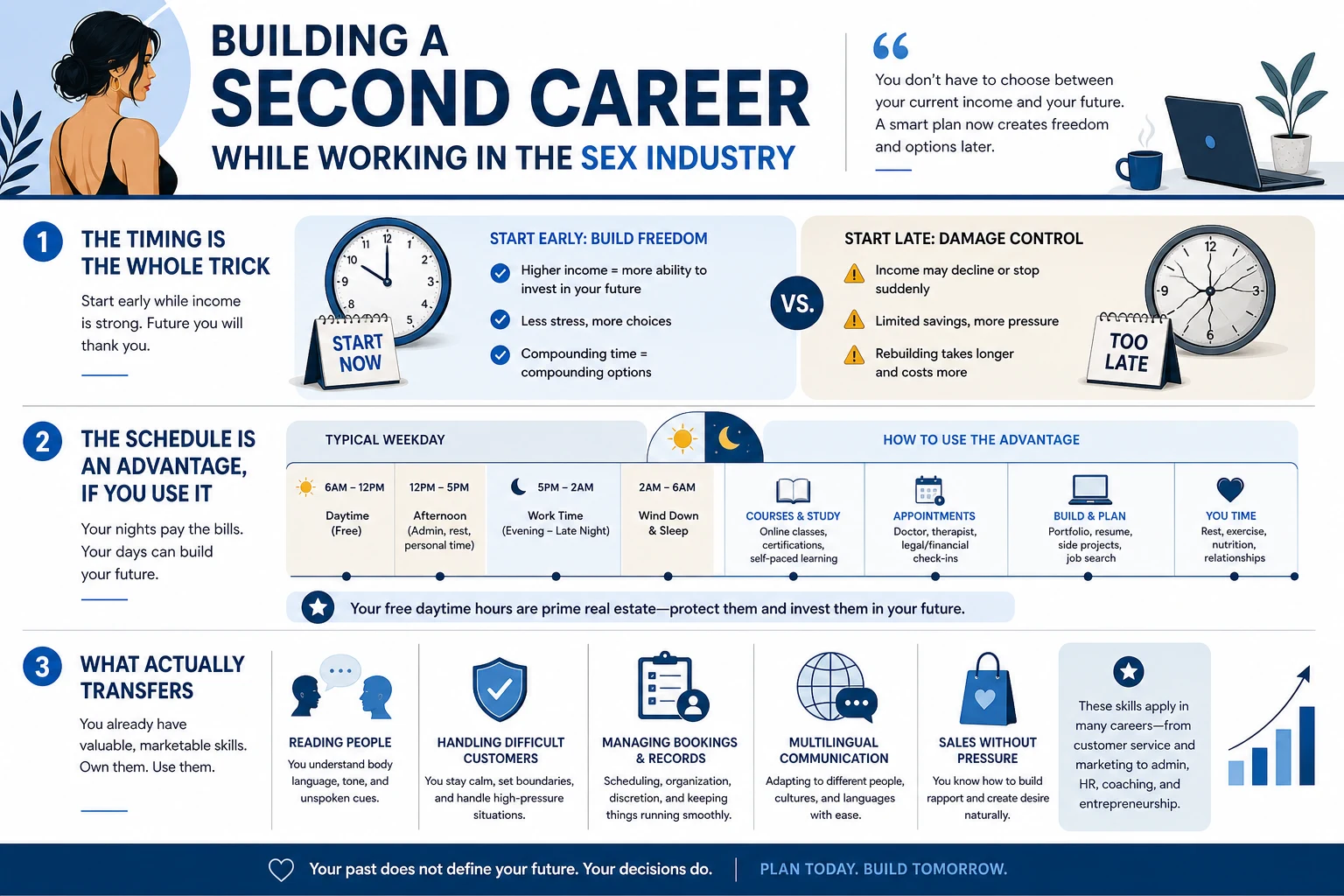
The timing is the whole trick
A second career built during the good years is a choice. One attempted after the income has dropped, or after an illness, or after a decision made for you, is damage control. The difference is not effort or talent, it is simply when you started, and starting is easiest precisely when it feels least necessary.
Money is the first half of this and time is the second. The financial side is covered in budgeting on irregular income, and the longer horizon in the wider discussion of saving for your post-career life. Neither works without the other.
The schedule is an advantage, if you use it
Night work leaves weekday daytime free, which is when courses run, offices are open and appointments are available. That is a genuine structural advantage over people with conventional jobs, and it is usually spent sleeping and recovering because the nights are unmanaged rather than because the time does not exist.
Protecting two fixed daytime slots a week is enough for a qualification over a couple of years. It requires the working schedule to be deliberate rather than reactive, which is the argument in setting working hours that do not burn you out: the free time only exists if the night before was planned.
What actually transfers
More than people assume, and none of it needs to be explained in terms of this industry. Reading people quickly. Handling difficult customers without escalation. Working to cash, managing your own bookings, keeping your own records. Languages picked up from an international clientele. Selling something without pressure. Every one of those is a described, ordinary competence in hospitality, sales, beauty, events, care work and administration.
Taking the job seriously as work is what makes the transfer visible to you as well as to anybody else, which is the point of sex work is a profession. People who think of these years as a gap describe themselves as having no experience, which is untrue and expensive.
The paperwork question
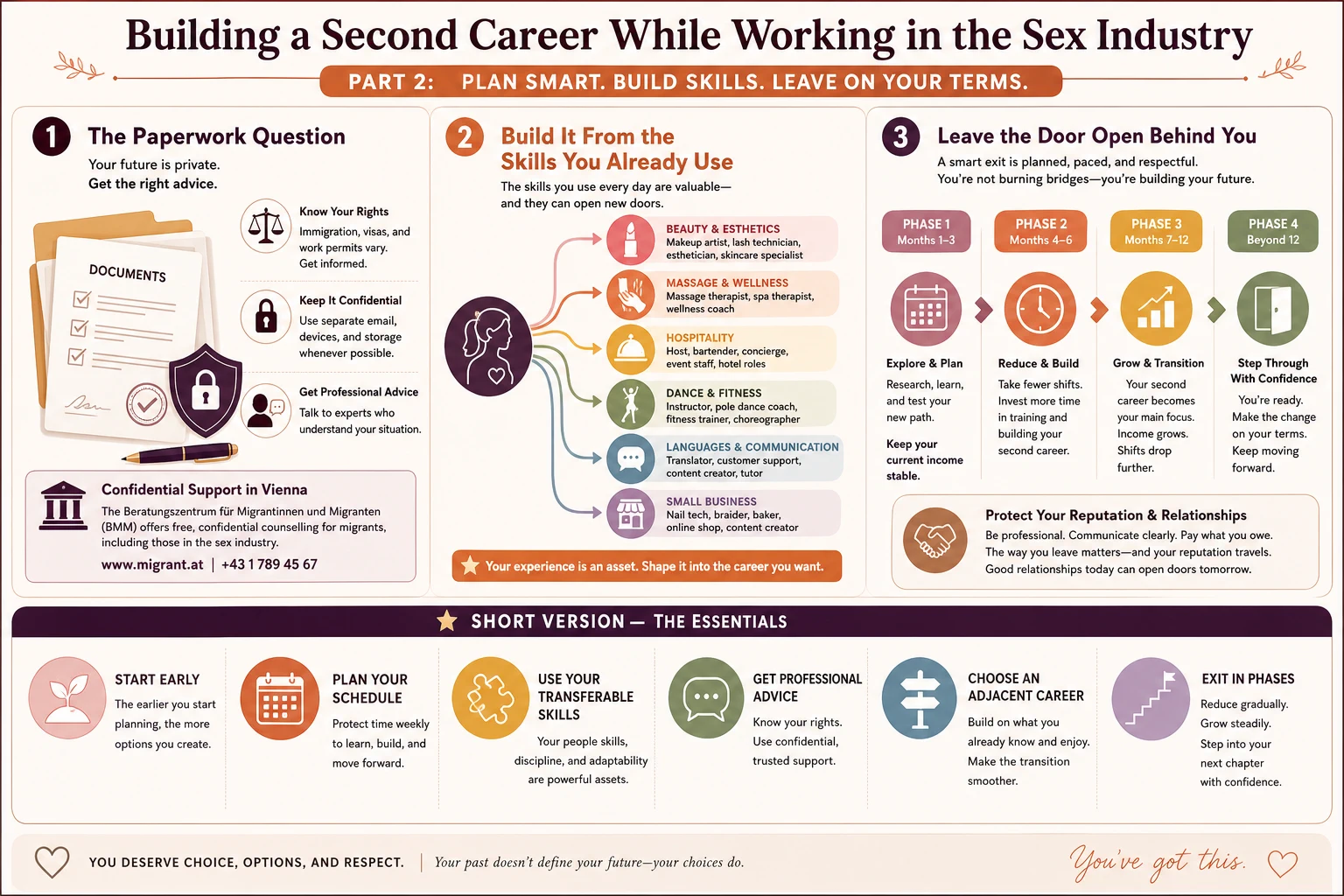
How you account for these years on paper is a real problem with practical solutions, and it is a question for somebody who handles it professionally rather than for a colleague or a forum. Self-employment, a registered activity and the period covered are all facts that can be stated without describing the sector, and many people do exactly that.
Vienna’s counselling centre for sex workers offers career planning alongside its legal and insurance advice, free and anonymously, in several languages; the services are listed on Sophie’s English information page. It is the right first conversation, and it is free, which makes postponing it hard to justify.
Build it from the skills you already use
The successful second careers in this industry tend to be adjacent rather than opposite: beauty and cosmetics, massage and bodywork, hospitality management, dance and fitness instruction, languages and translation, or running a small business of your own. Those paths use what you have instead of starting from zero, which is why they finish.
The traits that make somebody good at this job are the same ones that make a small business survive, which is the observation behind the traits successful escorts share: discipline, judgement about people, and the ability to keep working on a night nobody feels like working.
Leave the door open behind you
Most people stop and start more than once, and the transition is rarely a single clean exit. That makes your reputation in a house worth protecting: leaving well means you can come back, and leaving badly closes an option you may want in two years. The etiquette of it is set out in how to quit working at a Vienna club without hard feelings.
A phased exit is usually the realistic version: fewer shifts as the other work grows, rather than a date circled on a calendar. It is less dramatic and much more likely to hold.
The short version
Build the second career while the income is good, because doing it later turns a choice into damage control. Use the weekday daytime the schedule gives you, protecting two fixed slots a week, which requires the nights to be planned. Recognise that reading people, handling difficult customers, languages and running your own bookings are ordinary transferable competences.
Get the paperwork question answered by a counselling service that handles it professionally, choose an adjacent path rather than an opposite one, and plan a phased exit rather than a date. Leave every house on good terms, because most careers here stop and start more than once.