




Budgeting on a salary is arithmetic. Budgeting on income that arrives in bursts is a different discipline entirely, and it is the one skill that separates people who leave this industry with something from people who leave it with nothing. The work can pay well. What it does not do is pay evenly, and a plan built on the good weeks fails in the ordinary ones.

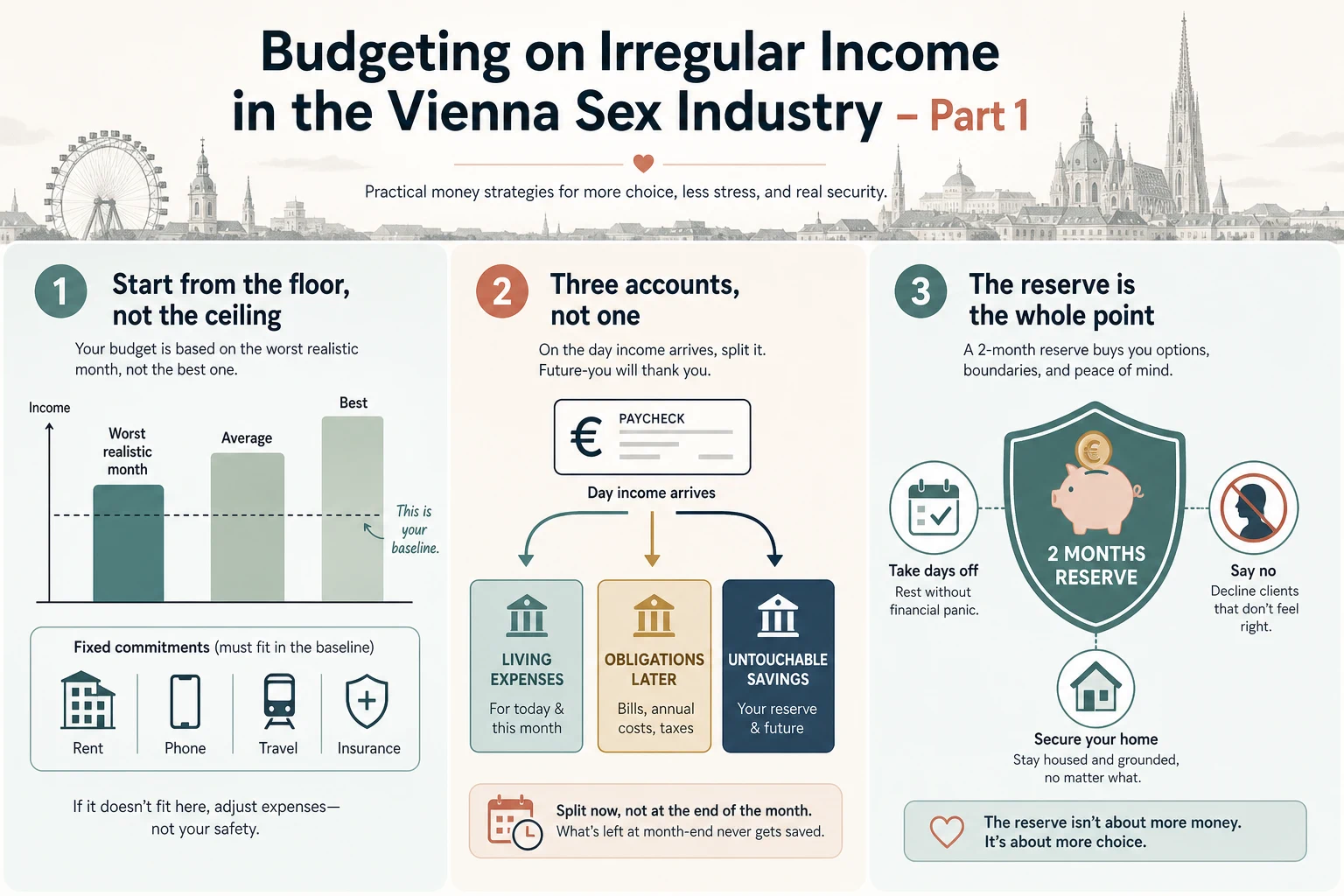
Start from the floor, not the ceiling
Write down the worst realistic month you have had, not the average and certainly not the best. That number is your planning baseline, and every fixed commitment you take on should fit inside it. Rent, phone, travel and insurance belong in that column; everything else is discretionary by definition.
This feels pessimistic and it is simply accurate. Demand in Vienna moves with the season, the weather, city events and the holiday calendar, and a quiet stretch is a normal feature rather than a personal failure. How uneven the pattern is becomes clear within a few months, and the realistic picture of it is part of the earning potential of sex workers in Vienna.
Three accounts, not one
The simplest system that works: one place for money you live on, one for money set aside for obligations that arrive later, and one you do not touch. The second is the one people skip, and it is the reason a predictable bill becomes an emergency. Separating the three physically, in different accounts, matters more than any spreadsheet, because it removes the decision at the moment when you are least inclined to make it well.
Split the money on the day it arrives rather than at the end of the month. Every practical saving guide for this industry reaches the same conclusion, including the concrete suggestions in nine ways to save money while working in Vienna.
The reserve is the whole point
Two months of your baseline costs, held untouched, changes what this job feels like. It lets you refuse a client you do not want, decline a badly timed shift, take a week off when you are ill and leave a house that turns out to be badly run. Every one of those decisions is unavailable to somebody working from this week’s takings.
That is why the reserve is a working condition rather than a financial luxury. It is also what makes a sustainable schedule possible at all, which is the connection made in setting working hours that do not burn you out.
Obligations that arrive later
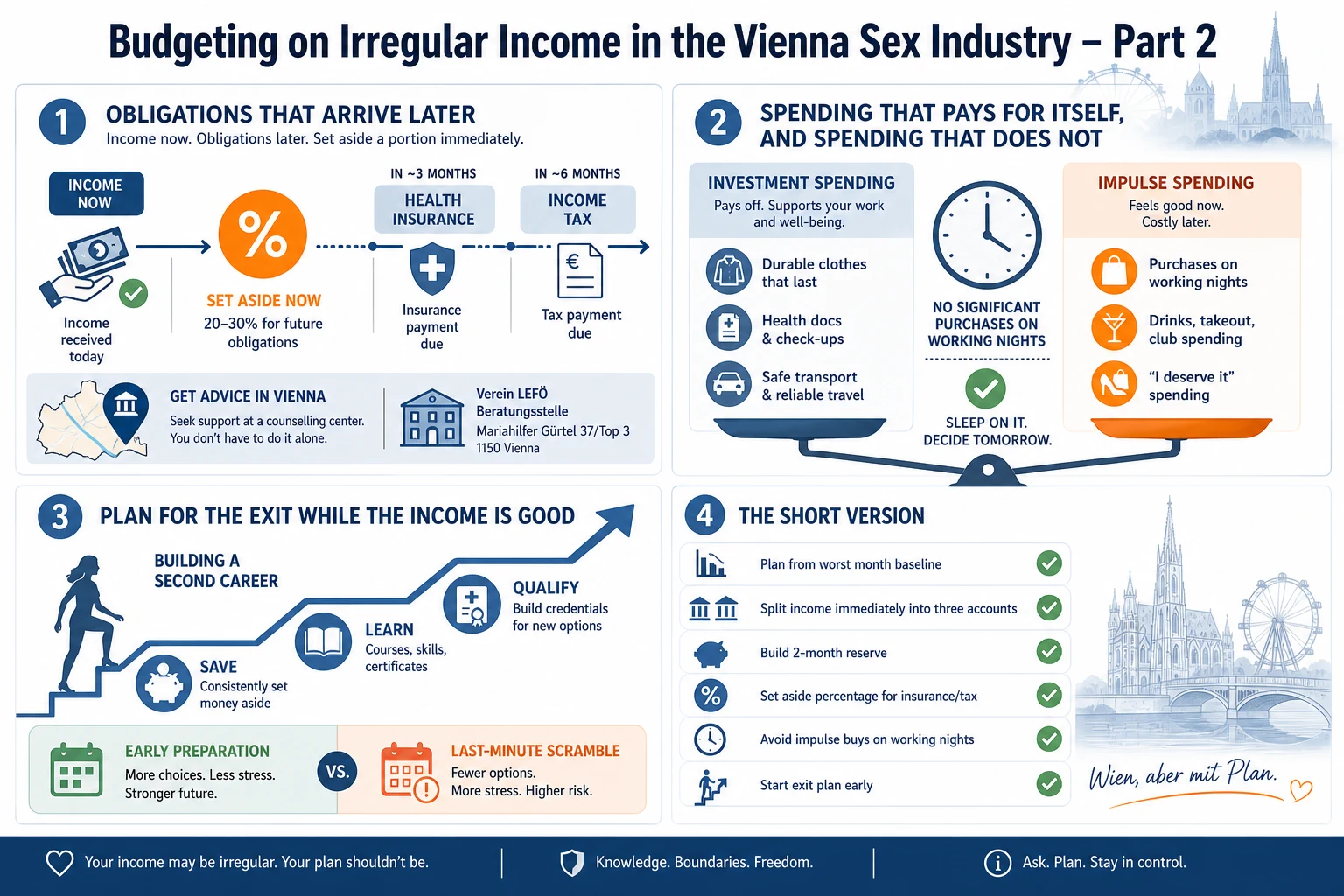
Self-employment means some costs are not deducted for you and appear as a bill months after the income that generated them. Insurance contributions and tax are the two that surprise people, and the surprise is always the timing rather than the existence. Setting aside a fixed percentage of every payment from the first week is the only method that reliably works.
What applies to you specifically depends on how you work and on your residence situation, and it is worth getting that answered properly rather than from a colleague. Vienna’s counselling centre for sex workers, Sophie, advises free and anonymously on tax and insurance questions in several languages, as listed on its English information page.
Spending that pays for itself, and spending that does not
Some costs in this profession are investments: clothes and shoes that survive a working week, the health documentation, transport that gets you home safely at four in the morning. Others feel like investments and are not, particularly anything bought during or immediately after a good night, when judgement is at its weakest.
A simple test that costs nothing: nothing significant is bought on a working night. Decisions made the following afternoon are almost always better, and the ones that survive until then are usually the right ones. There is a longer treatment of this in how to spend your money properly in this industry.
Plan for the exit while the income is good
Nobody works in this industry forever, and the people who leave comfortably are those who started preparing while they were still earning well. That preparation is usually financial and educational at the same time: money set aside, and a qualification or a skill built in the daytime hours the job leaves free.
Treating that as a project from the first year rather than the last is the difference between choosing when to stop and being forced to. The practical version of it is set out in building a second career while working in the sex industry.
The short version
Plan from your worst realistic month, not your average, and keep fixed commitments inside that number. Split every payment on the day it arrives into living money, money for obligations that come later, and untouchable savings. Build two months of baseline costs as a reserve, because that reserve is what buys you the right to say no.
Set aside a percentage for insurance and tax from the first week, get advice on your specific situation from a counselling service rather than the dressing room, buy nothing significant on a working night, and start building the exit while the income is still good. None of it is complicated, and all of it is easier in the first month than in the third year.