




An interview in this industry runs in one direction by default. The house asks the questions, you answer them, and somewhere in the conversation an arrangement is agreed that will shape your working life for months. The women who end up in good houses are almost always the ones who turned that around and asked their own questions first. A serious club expects it. A club that resents it has told you everything you needed to know.

Ask about money in specific terms
Not “how much can I earn”, which invites a sales answer, but the mechanics: what does the house take and on what basis, is there a room or shift cost, who sets the prices, when and how are you paid, and what happens on a night with no clients. Four precise questions produce a clearer picture than an hour of general conversation.
Write the answers down afterwards. Verbal arrangements drift, and a written note of what was said protects you from a misunderstanding that is nobody’s fault in particular. The wider financial reality this sits inside is covered in budgeting on irregular income.
Ask what the house requires of you legally
A legitimate Vienna house will insist on registration and a current health examination, and will say so without being asked. If a club is relaxed about either, that is not flexibility, it is a warning that other rules are equally negotiable, and the consequences land on you rather than on them.
The documentation route is documented and manageable, in how to get your licences and papers and how to apply for the Green Card health exam. The official framework for the sector is published by the city on the City of Vienna’s prostitution information pages.
Ask about hours, and about saying no to them
How long is a shift, how many are expected per week, is there a minimum, and what happens if you decline one. The last question is the important one, because the answer reveals whether you are being offered a working arrangement or something closer to control. A house that cannot answer it calmly is not a house for you.
Your own schedule should already exist before this conversation, so you are matching an offer against a plan rather than accepting whatever is proposed. How to build that plan is the subject of setting working hours that do not burn you out.

Ask what happens when something goes wrong
Is there security on site during every shift, who do you go to about a difficult client, is a client ever refused entry or removed, and has it happened. These are the questions that distinguish a managed house from a room with a door. The answers are usually immediate and confident in a serious venue, because they have the procedures and they are proud of them.
The structural reason this matters is that a house with real management has no role for the informal figures who exploit people in unregulated settings. That mechanism is described in how high-class houses in Vienna protect workers from pimps, and it is one of the strongest practical arguments for working somewhere with visible structure, such as an established high class club with on-site management, rather than alone in an apartment.
Ask about privacy and about leaving
Two questions people forget until they need them. What does the house do with your documents and your data, and is anything published with your photograph or your name. And second: what is the notice arrangement if you want to stop, and has anyone left recently on good terms.
How a house handles departures is one of the most reliable indicators of how it handles everything, and the practical etiquette of leaving well is set out in how to quit working at a Vienna club without hard feelings. Ask at the beginning, not at the end.
What the answers tell you
Content matters less than manner. A house that answers precisely, without irritation, and offers information you did not ask for is a house that has nothing to hide. A house that answers vaguely, changes the subject to how much you could earn, or suggests the paperwork is optional has answered the only question that mattered.
Preparation also prevents the standard beginner errors on your side of the table, most of which come down to arriving without documents, without questions and without a plan.
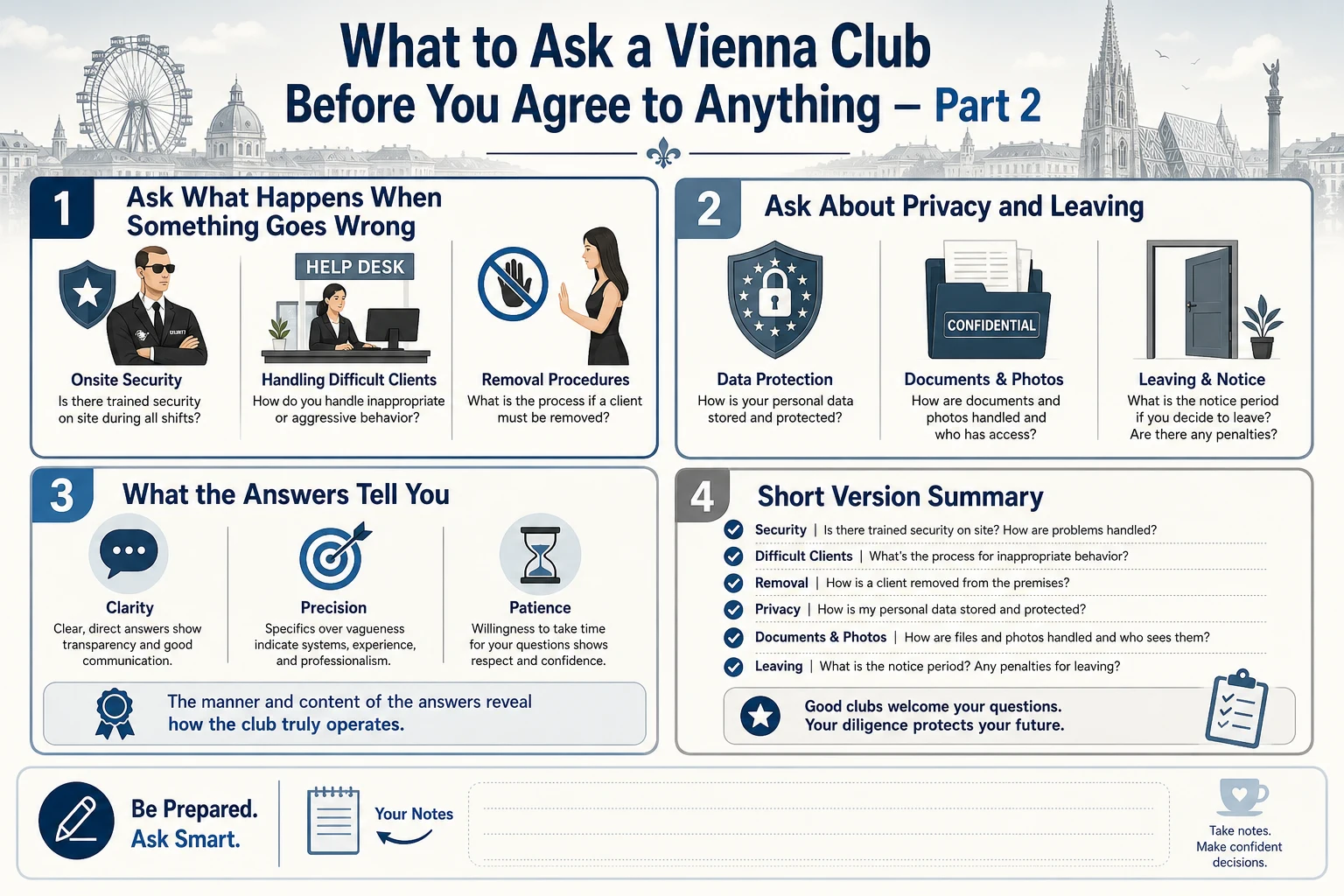
The short version
Go into the conversation with your own list. Ask the money mechanics rather than the earning potential, confirm that registration and the health examination are required, establish shift expectations and what happens if you decline one, and find out who handles a difficult client and whether security is present.
Ask what happens to your documents and your photograph, and how people leave. Then judge the manner of the answers as much as their content: precision and patience mean a managed house, vagueness and an early pivot to money mean the opposite. Write everything down the same day.