




Insurance is the subject that gets postponed in this profession, and the reason is understandable: it is administrative, it costs money now for a benefit that is theoretical, and nobody at work has a complete answer. It is also the difference between an illness being an inconvenience and an illness being a catastrophe. Working legally in Austria puts you inside a system rather than outside it, and the practical question is what your own position in that system actually is.

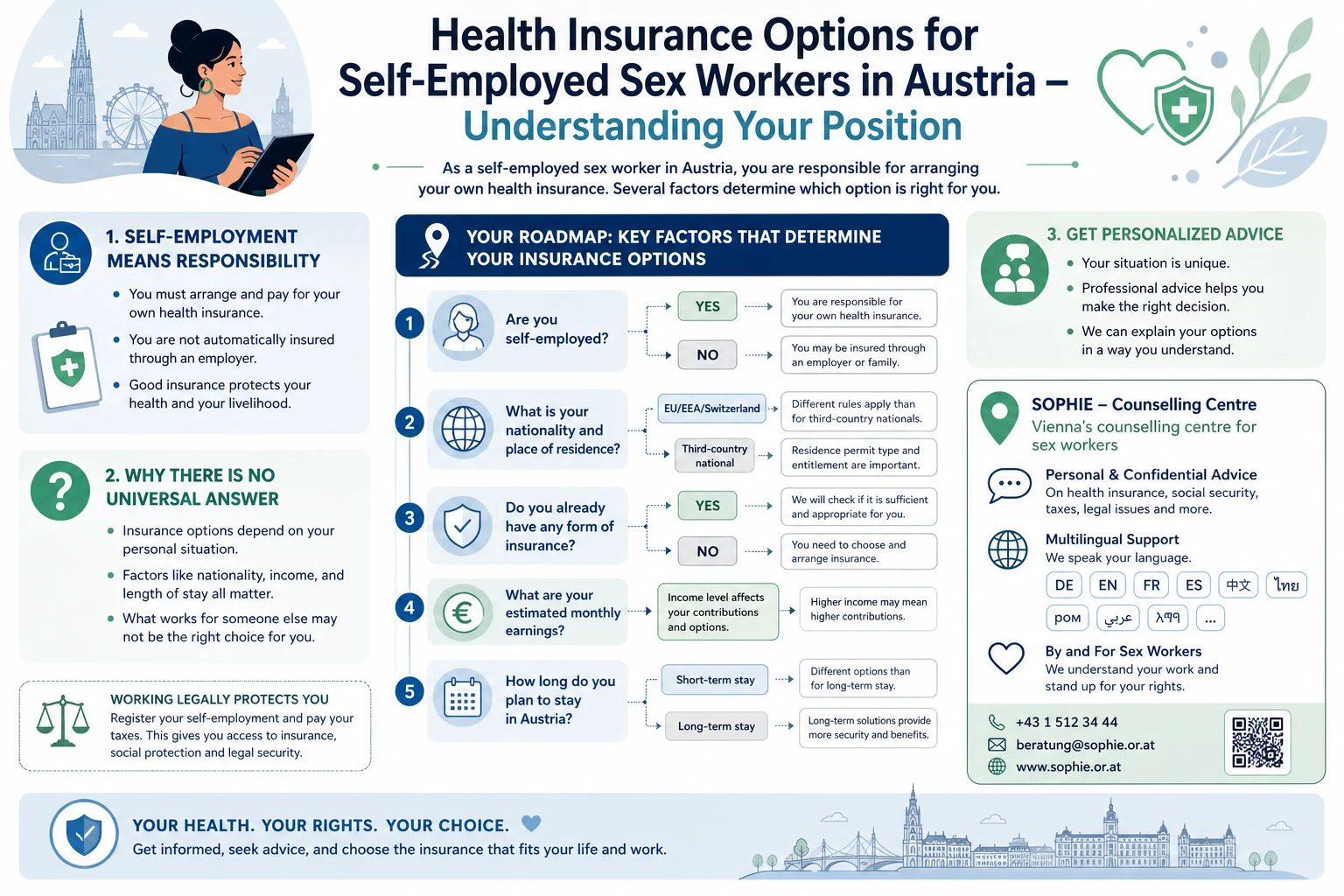
Self-employed means it is your responsibility
Most sex work in Vienna is done on a self-employed basis rather than as employment, and that single fact drives everything else. Nobody deducts contributions on your behalf, nobody enrols you automatically, and nothing happens quietly in the background. What you do or do not arrange is what you have.
This is the same position as any independent trader in Austria, and it is one of the underrated arguments for working within the legal framework at all: being registered is what makes the system accessible to you. The consequences of the alternative are set out in why not to work illegally in apartments in Vienna.
Why nobody can give you one universal answer
Your situation depends on several things at once: whether you work as a self-employed person or in some other arrangement, your nationality and residence status, whether you have insurance in another country, how much you earn and how long you intend to stay. Two colleagues in the same house can be in genuinely different positions.
This is why dressing-room information is unreliable here. It is not that colleagues are careless; it is that their answer is correct for their own circumstances and often several years out of date. On this subject, second-hand information is worse than none, because it feels like knowledge.
Where to get an answer that applies to you
Vienna has a counselling centre specifically for sex workers, Sophie, and insurance is one of its standard advice topics alongside tax, health and the legal framework. The service is free, anonymous and available in several languages including Hungarian and Romanian, which matters in a profession where much of the workforce is international; the details are on Sophie’s English information page.
Between that service and one conversation, most people get a clear picture within a week, which is considerably faster than the years this subject usually gets postponed.
Budget for it before it is due
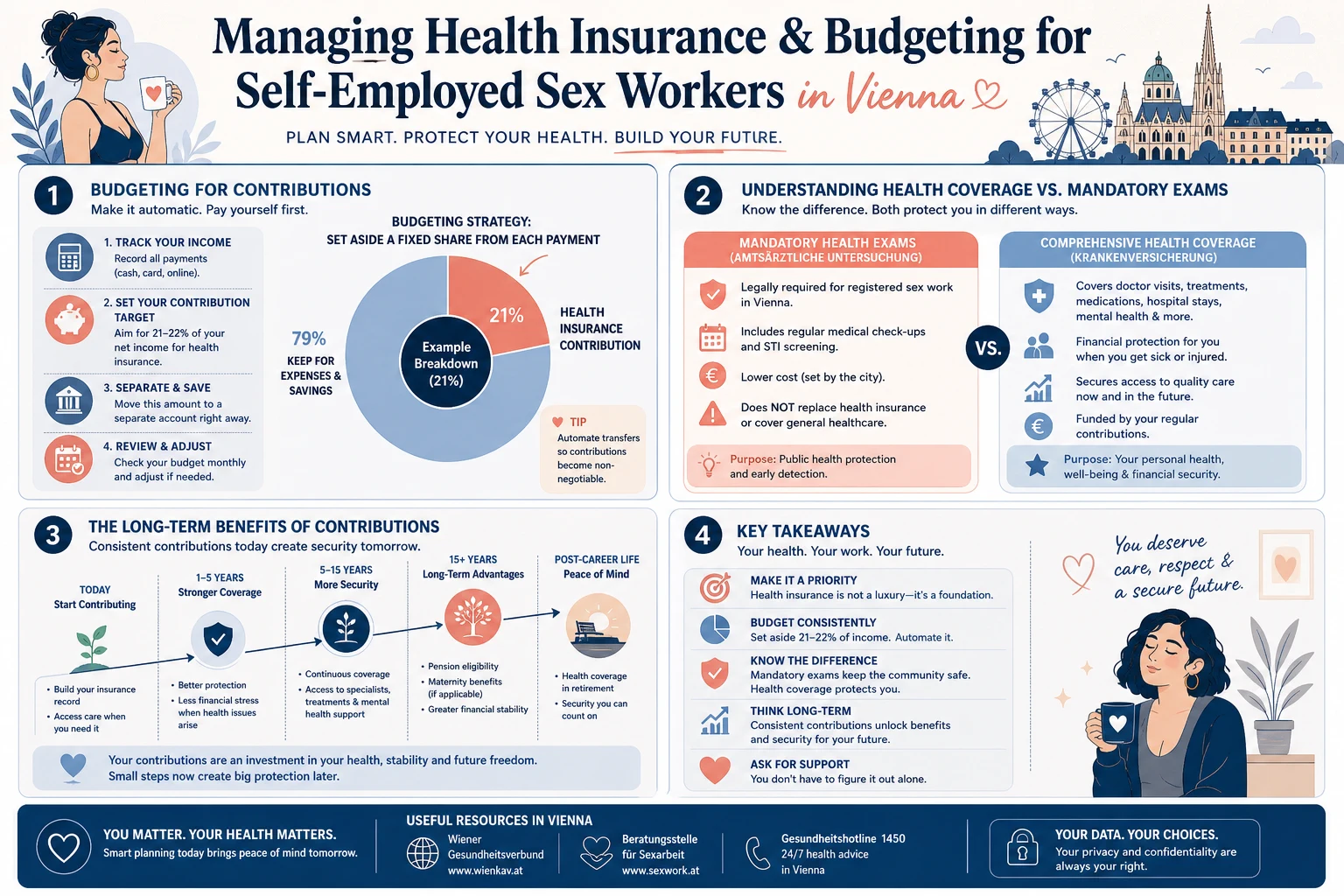
Whatever your arrangement turns out to be, contributions and tax arrive as bills rather than as deductions, and usually later than the income that produced them. Setting aside a fixed share of every payment from the first week is the only method that survives a bad month, and it converts an alarming bill into an administrative one.
That habit belongs to the same discipline as everything else about uneven income, which is covered in budgeting on irregular income in the Vienna sex industry. People who separate the money on payday are never surprised by it.
Health cover is the part that pays for itself
The mandatory health examination is a workplace requirement, not health care, and confusing the two leaves a real gap. Everything else, from a flu that stops you working for a week to anything that needs a specialist, sits outside it. In a profession with no sick pay, cover is what makes an illness survivable rather than financially serious.
Vienna has established sexual health services, and using them is routine professional maintenance rather than a sign of a problem. The documentation side of the job is explained in how to apply for the Green Card health exam.
The long view
Contributions are not only about this year. Time spent inside a formal system counts towards things that matter much later, and years worked outside it count towards nothing at all. That is an unglamorous argument and it becomes the most important one in your forties. The same logic drives the longer financial horizon set out in saving for your post-career life.
It is also why insurance and exit planning belong in the same conversation, alongside savings and whatever you are building for afterwards, as described in building a second career while working in the sex industry.
The short version
Sex work in Vienna is usually self-employment, which means insurance and contributions are yours to arrange and nothing happens automatically. Your exact position depends on your status, your nationality, your earnings and any cover you already hold elsewhere, so colleagues cannot answer it for you and often answer it wrongly.
Get advice from the counselling service that handles this professionally, free and anonymously, and read the city’s own information pages. Set aside a fixed share of every payment from the first week, remember that the mandatory health examination is not health cover, and treat contributions as part of the long view rather than a cost this month.