




Saying no is a professional skill in this work, not a failure of one. Every experienced sex worker in Vienna declines requests regularly, and the ones who do it well keep the client, keep the evening pleasant and keep their own limits intact. The ones who do it badly either lose bookings unnecessarily or, much worse, end up agreeing to things they did not want because the refusal felt harder than the compliance.

Decide your list before you are asked
The only refusals that come out calmly are the ones already decided. Write your own list once: what you offer, what you never offer, and what depends on the situation. Three categories, held in advance, remove the moment of hesitation that a persistent client reads as an opening.
One item deserves particular clarity because it is asked for constantly and carries real consequences, and the reasons to hold that line are set out in what AO means and why it is bad for sex workers. A limit that protects your health is not negotiable at any price, and pricing it at all is the mistake.
Refuse the request, not the person
The whole technique is in that distinction. “I do not offer that” is about a service. “I would not do that with you” is about him, and it ends the booking along with the request. Keep the sentence short, factual and free of judgement, and then move on to something you do offer, which gives the conversation somewhere to go.
Offering an alternative in the same breath is what keeps the client. Most requests are exploratory rather than insistent, and a man who hears a clear no plus a clear yes usually takes the yes. That is ordinary professional handling, the same competence discussed in the traits successful escorts share.
Do not explain, and do not apologise twice
Explanations invite negotiation, because every reason can be argued with and a reason offered is a door held open. “That is not something I do” needs no expansion. One brief pleasant word is plenty; a second one signals that you are uncomfortable, and discomfort is exactly what a pushy client works with.
Tone carries this more than vocabulary. Said lightly, a refusal is unremarkable. Said apologetically, the same sentence reads as a starting position, which is why practising the words until they are boring to say is worth the ten minutes it takes.

Written requests are different
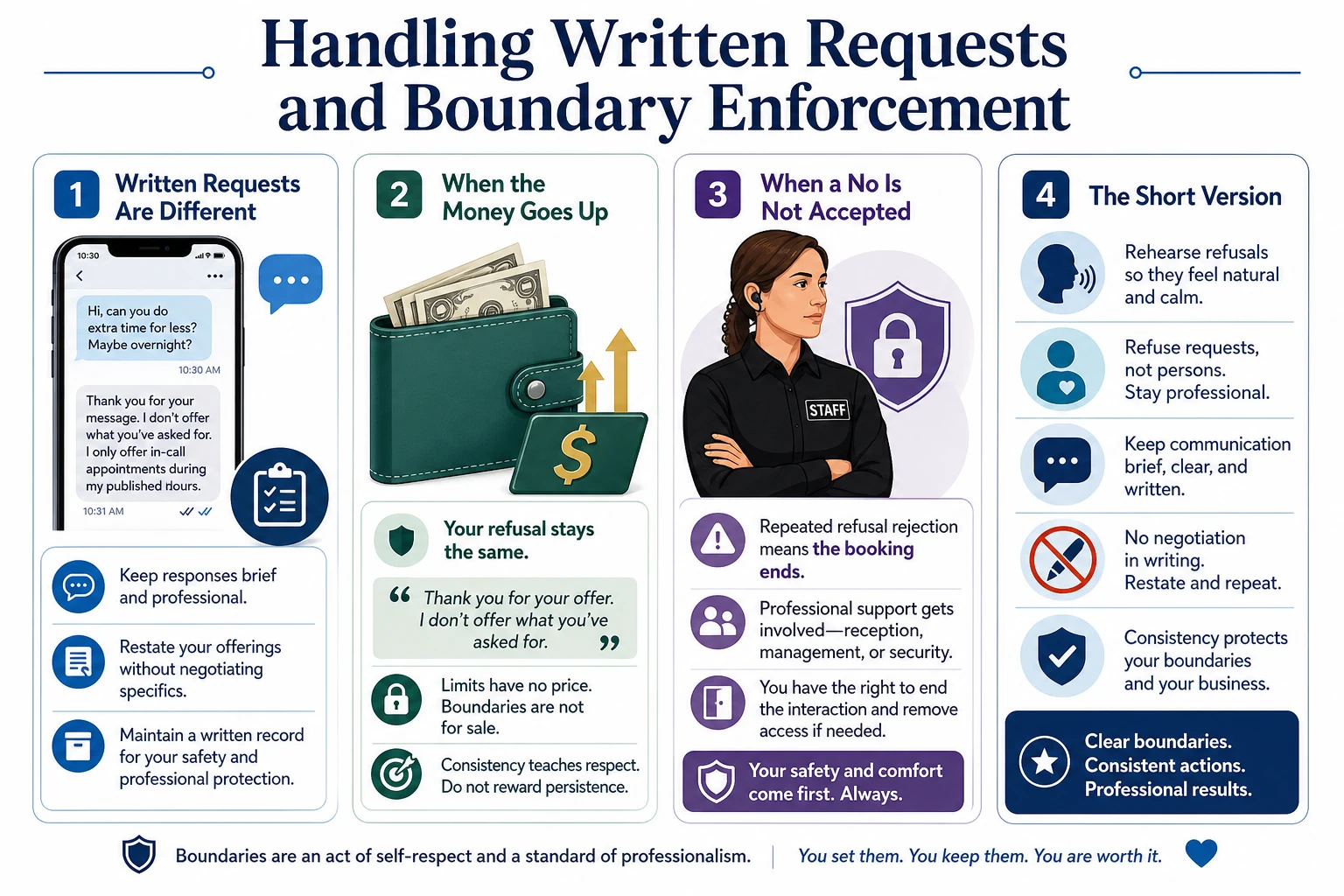
In messages you have time, which is an advantage, and a record, which is a responsibility. Answer briefly, restate what you offer, and do not negotiate specifics in writing. Anything you write can be screenshotted and shown to somebody else, including as a claim about what you supposedly agreed to.
The practical rules for this channel are covered in how to use WhatsApp as a sex worker and in the broader point made by when written words matter in contact with clients. A short written no is also the easiest kind to hold, since nobody is standing in front of you.
When the money goes up
A higher offer for something on your no list is the moment the list either means something or does not. The answer is the same sentence as before, unchanged, because a limit with a price is not a limit and both of you will know it immediately. Clients who test this are usually not malicious; they are simply finding out whether the rules are real.
Holding the line costs one booking and buys every future evening with that person, since the question stops being asked. Consistency across all clients is what makes it effortless rather than a confrontation each time, which is the same principle that governs handling regular clients without losing your boundaries.
When a no is not accepted
Repeating a request after a clear refusal is a decision by him, not a misunderstanding. At that point the booking is over, and in a house with staff on site the answer is not yours alone to enforce: reception and security exist precisely for this, and using them is expected rather than dramatic.
This is the clearest practical difference between working somewhere managed and working alone, and it is spelled out in how high-class houses in Vienna protect the people working in them. Free and anonymous advice on difficult situations is also available from Vienna’s counselling centre, described on Sophie’s English information page.
The short version
Decide your three lists in advance, because only rehearsed refusals come out calmly. Refuse the request rather than the person, keep the sentence short and factual, and offer an alternative in the same breath, which is what keeps the booking. Explain nothing, apologise once at most, and let the tone do the work.
In writing, stay brief and negotiate nothing. When a higher offer arrives for something on the no list, repeat the same sentence unchanged, because a limit with a price is not a limit. And when a refusal is not accepted, the booking is finished and that is what the people at the door are there for.