




The assumption in this industry is that the money is at night, and for a long time that was simply true. It is less true than it was. A steady minority of sex workers in Vienna now build their week around daytime hours, and they are not doing it because they cannot manage late shifts. They are doing it because the arithmetic, once you count everything rather than just the takings, often comes out in favour of daylight.

Who is out there in the afternoon
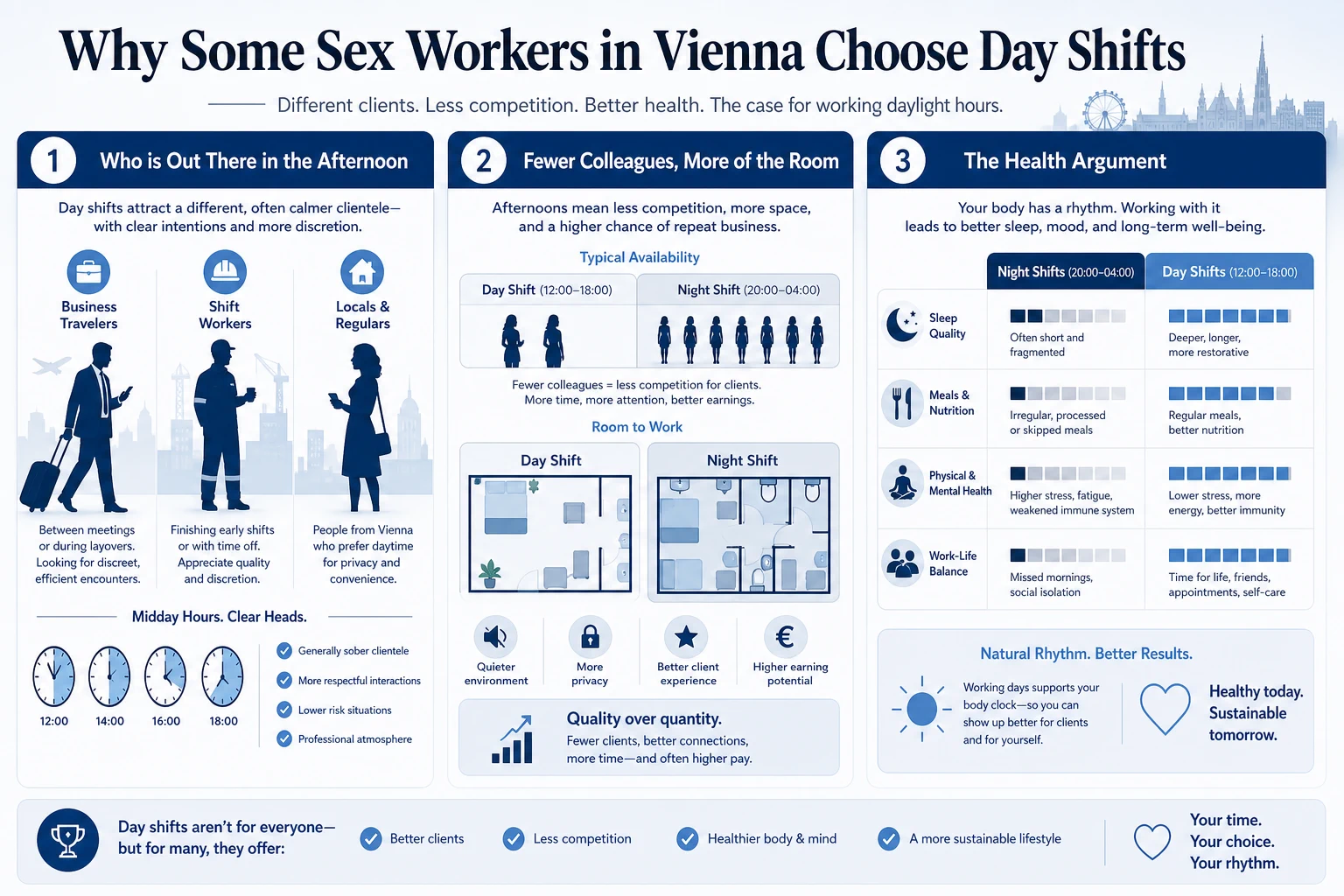
A different clientele, and a more predictable one. Men on a work break, shift workers whose free time is other people’s working hours, business travellers with an afternoon gap, and locals who prefer a quiet room. They arrive sober, they know what they came for, and they leave on time because something else is waiting.
That last detail is worth more than it sounds. A client with a schedule is an easier client than one with an open evening, and the encounters are shorter, calmer and less negotiated. Alcohol, which is behind most difficult situations in this work, is largely absent from a Tuesday afternoon. How the trade divides across the week is visible from the client side too, in how busy Vienna venues are on weekends versus weekdays.
Fewer colleagues, more of the room
Daytime rosters are thinner, which means less competition for the clients who are there. In a night shift with a full roster you may spend hours waiting; in a quiet daytime shift with three colleagues, a modest number of visitors can still make the shift worthwhile. The takings per client are usually similar, since houses rarely discount private time by the hour.
This is also why daytime suits people who are new or returning: less noise, more time to learn the house, and colleagues who are not rushed. The wider question of when the trade is busy and when it is not is one of the practical themes in working through slow periods.
The health argument
Night work has a measurable physical cost that accumulates over years: disrupted sleep, late meals, and a body that never quite settles into a rhythm. Daytime shifts remove most of it. You sleep at night, you eat at normal hours, and you keep a life that overlaps with everybody else’s.
Over a career this is not a small factor, and it interacts with everything else: people who sleep properly work more consistently and last longer in the profession. The scheduling side of that is covered in setting working hours that do not burn you out.
What daytime costs you
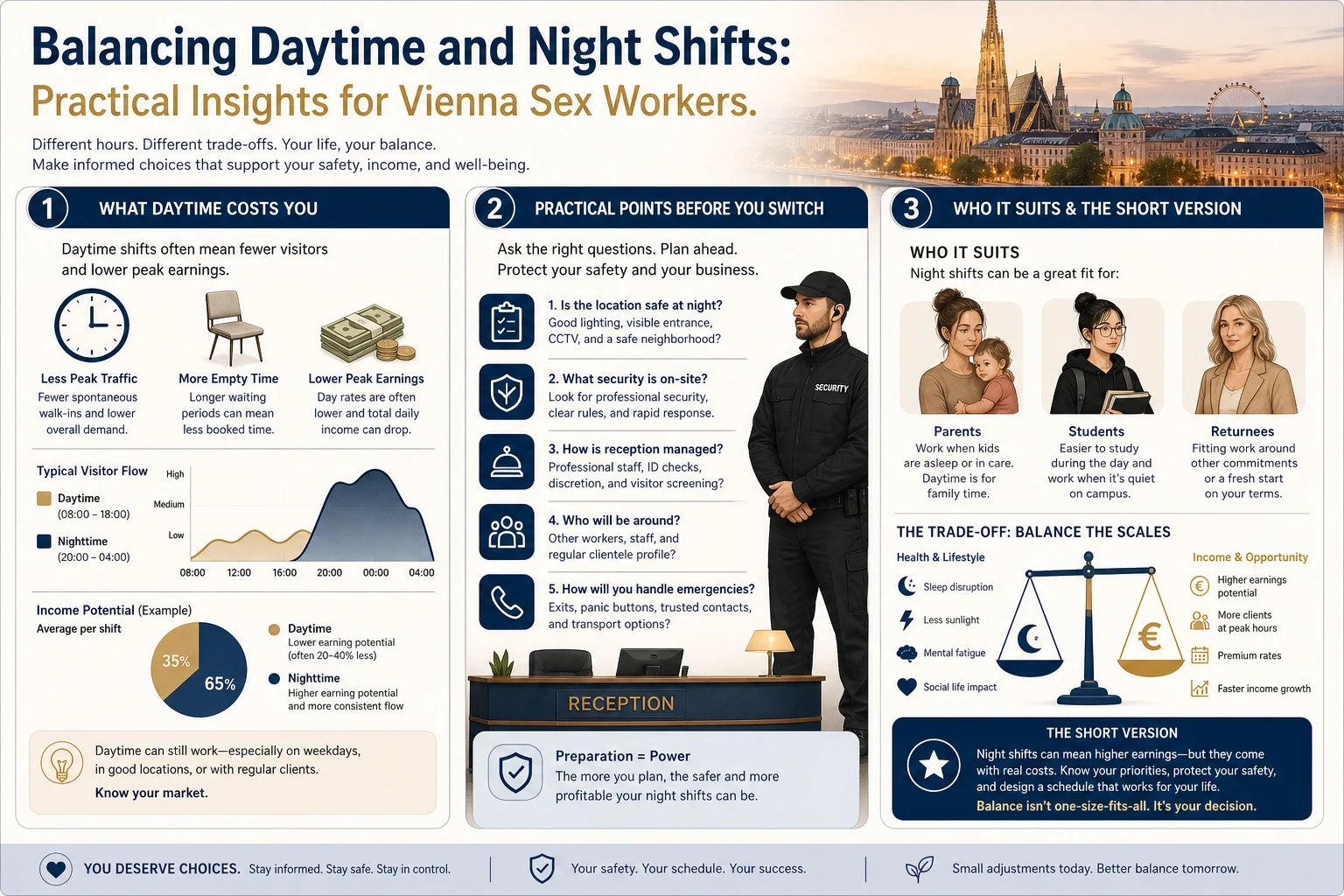
Honesty requires the other column. Peak earning hours are at night, especially at weekends, and a purely daytime week will usually earn less than a purely night one. Fewer visitors means more empty time, which is boring and unpaid. And not every house opens early, so your choice of workplace narrows.
A mixed week is the common compromise: daytime shifts on weekdays, one or two evening shifts where the money concentrates. That keeps the peak income and most of the health benefit, and it is what most people who try daytime actually end up doing.
Practical points before you switch
Ask the house directly whether daytime shifts exist and how many colleagues typically work them, because a daytime shift alone in an empty building is a different proposition entirely. Ask who is on site: reception and security matter more in quiet hours, not less. And ask how the arrangement changes, if at all, for daytime.
Those are the same questions worth asking about any house before agreeing to anything, collected in what to ask a Vienna club before you agree to anything. The presence of on-site structure is the part that makes a quiet shift safe rather than isolated, which is the argument in how high-class houses protect the people working in them.
Who it suits
People with children or daytime obligations who need the evening at home. People returning after a break who want a gentler restart. Anyone whose sleep has already been damaged by years of nights. And anyone studying or building something else, since the trade-off there is inverted: evenings free for the work, daytime for the shift.
It suits less well anybody whose income target depends on peak hours, or who finds empty time harder than busy time. Both are legitimate, and the answer is a mixed week rather than a principle.
The short version
Daytime shifts in Vienna bring a sober, time-limited clientele, a thinner roster and therefore less competition, and a working rhythm that does not damage your sleep. Takings per client are usually unchanged, which is why a quiet shift can still be worth working.
The cost is real too: the peak hours are at night, empty time is unpaid, and not every house opens early. A mixed week captures most of both, so ask any prospective house how many colleagues work the daytime and who is on site during it, and treat the health benefit as a long-term investment rather than a preference.