



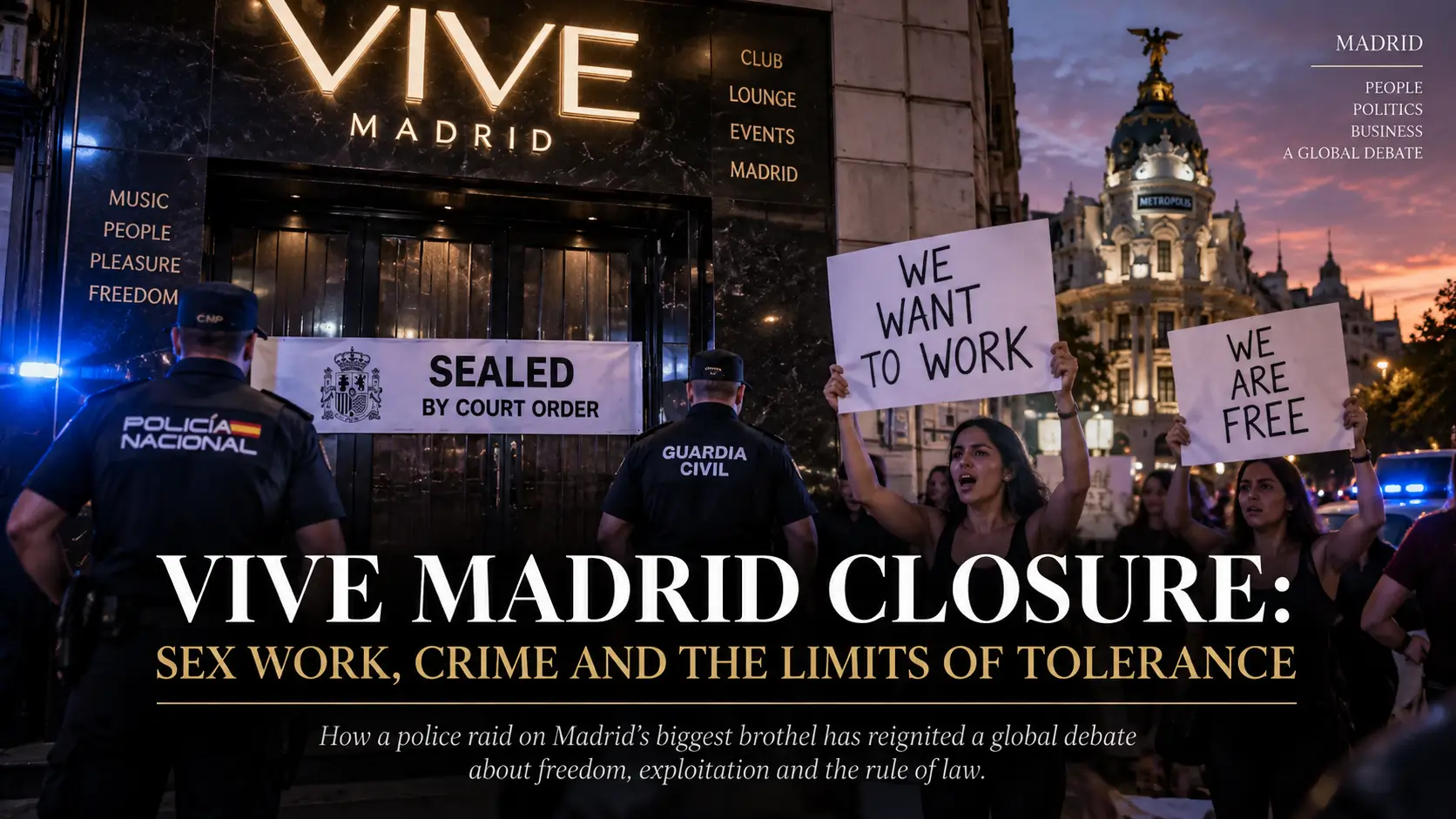
Spanish authorities have shut down Vive Madrid, widely described as the largest brothel in the Spanish capital, following a court order connected to a major criminal investigation. The case has drawn attention not only because of the size of the establishment, but because it raises a difficult question: how should authorities distinguish between consensual sex work and criminal exploitation?
In June 2026, Spain’s National Police and Civil Guard sealed the premises in Madrid’s Tetuán district on the orders of the Audiencia Nacional. According to Spanish media reports, the investigation concerns allegations including human trafficking for sexual exploitation, money laundering and immigration-related offences.
Vive Madrid had been on the radar of law enforcement for years. Earlier investigations reportedly examined the conditions under which women worked at the establishment and the financial structures surrounding the business.

The venue was also linked in media reports to businessman Ángel Crispín Gilaranz Velasco, previously investigated in connection with Operation Pompeya. That case examined an alleged scheme involving hundreds of millions of euros in proceeds from prostitution across several Spanish regions. Investigators looked into the use of card-payment systems and intermediary companies allegedly employed to conceal the origin or destination of revenues.
The wider investigation has also raised questions about possible corruption within law enforcement. Spanish media reported that a Civil Guard lieutenant colonel was among those investigated over suspicions that individuals with institutional influence may have helped protect activities connected to the network. These remain allegations, and criminal responsibility must ultimately be established by the courts.
The women who wanted to keep working
One of the most striking scenes occurred during the closure itself. Around a dozen sex workers reportedly protested outside Vive Madrid, shouting slogans including “We want to work” and “We are free.”
Their reaction highlights an important distinction that is often lost in debates about prostitution.
Sex work performed voluntarily by consenting adults is not the same thing as human trafficking. Legal or regulated establishments can potentially provide workers with greater visibility and security than an entirely underground industry. They can also make working conditions and financial activities easier for authorities to inspect.
Simply closing every establishment where prostitution occurs does not necessarily eliminate prostitution. It can instead push the activity into apartments, private houses or other environments where exploitation may be harder to detect.
But tolerance cannot mean immunity from the law. If an establishment is used for trafficking, coercion, money laundering, immigration offences or other organised criminal activity, authorities have every reason to intervene. A legal business structure cannot become a shield behind which exploitation is allowed to operate.
Freedom requires protection from coercion
The Vive Madrid case therefore illustrates why the debate cannot simply be reduced to being “for” or “against” prostitution.
A society can recognise the autonomy of adults who voluntarily choose sex work while taking an uncompromising position against those who force or exploit others for profit.
In fact, the two principles belong together. If the allegations surrounding Vive Madrid are proven, its closure should not be viewed as punishment for consensual sex work. It should be viewed as action against suspected criminal activity.
At the same time, the voices of the women protesting outside should not be ignored. Protecting people from trafficking and respecting the choices of consenting adults are not contradictory goals.
The challenge is ensuring that the difference between the two is real, enforceable and never hidden behind the doors of an apparently legitimate business.